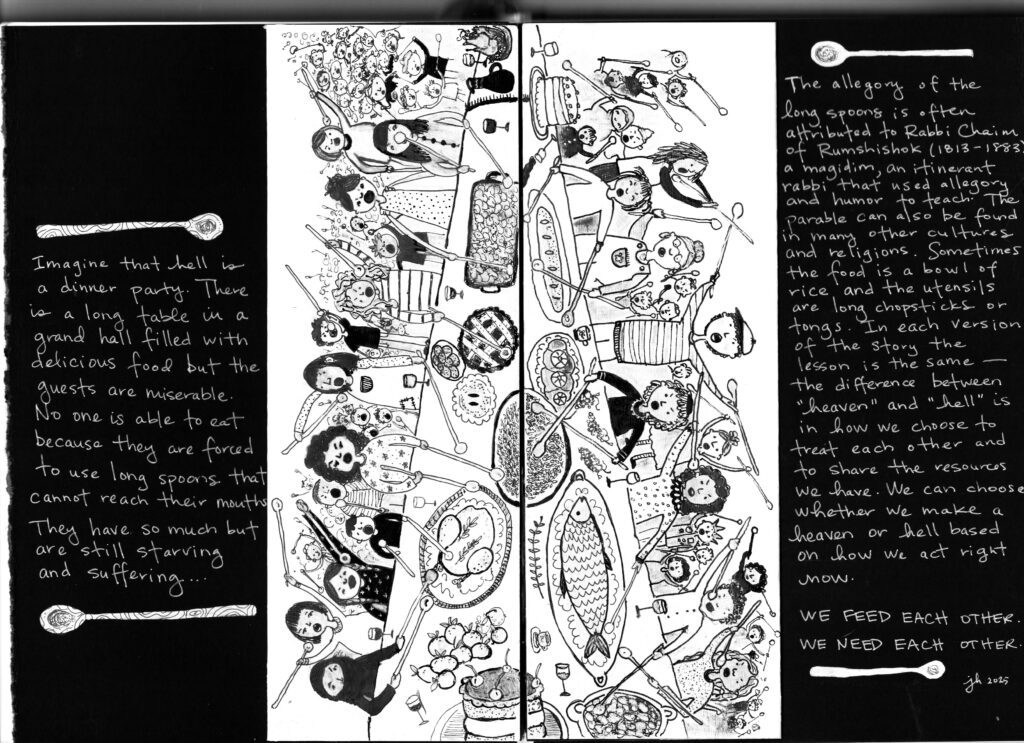

Imagine that hell is a dinner party. There is a long table in a grand hall filled with delicious food but the guests are miserable. No one is able to eat because they are forced to use long spoons that cannot reach their mouths. They have so much but they are still starving and suffering.
Imagine that heaven it’s a dinner party. There is a long table winding through the ruins of a destroyed city. The food is only a simple soup but the guests are joyful and well fed. Everyone is able to eat because they use their long spoons to feed each other. They have very little but choose to share what they have and it is enough.
The allegory of the long spoons is often attributed to Rabbi Chaim from Rumshishok (born Rabbi Chaim Elchanan Tzadikov z”l, 1813-1883) who was a magidim or itinerant rabbi that used allegories and humour to teach. The parable can also be found in many other cultures and religions, sometimes the food is a bowl of rice and the utensils are long chopsticks, other times a bowl of stew or tongs. In each version of the story the lesson is the same — the difference between “heaven” and “hell” is in how we choose to treat each other and share the resources we have.
“In hell, we are selfish. We would rather go hungry than give people we don’t care for the pleasure of eating. But in heaven, we feed each other. We put trust in those around us, and never go hungry.”
We feed each other because we need each other.